
Chlorine Testing
Midwest Microlab is capable of testing solid or liquid samples for total percentage of Chlorine with a range of 0.4% (4,000 ppm) to 100%. Accuracy for Chlorine testing is +/- 0.4. Please refer below for a brief description of the Chlorine analysis procedure including interferences and sample submission size. Air Sensitive / Glove Box handling is NOT available for Chlorine analysis.
Halogen Testing
Bromine Testing
Chlorine Testing
Fluorine Testing
Iodine Testing
Finding Total Percentage of Chlorine
Chlorine Analysis & Techniques
Midwest Microlab performs Chlorine analysis using the Schoniger Combustion Technique.
The solid sample is weighed into ashless paper and inserted into a custom-made Platinum stopper. The stopper is fitted with a flask that is charged with the appropriate reactants and oxygen. On combustion, the chlorine present is trapped as HCl.
The HCl gases are absorbed on the liquids and the resulting liquid is then removed. Titration with a standardized solution of Ag-perchlorate in I-proh.
The most common standard for this determination is Para-Cl Benzoic Acid available through the NIST. There are others that may be used on occasion.
Due to the exclusive use of the flask combustion in the Chlorine determination, we are not able to determine Chlorine on air-sensitive samples.
Interferences Associated with Chlorine Analysis:
Known Interference’s for Chlorine Analysis include: Al, Br, Eu, Hg, I, Mg, Na, Ni, Se, Si, Sn and Ti.
Bromine and Iodine react in the same manner; therefore these do create interference for Chlorine Analysis..
Please note the interferences above cannot be circumvented during analysis. Irregular results can be reported due to an interference within the molecular formula of the sample. Please note irregular results due to interferences cannot be interpreted by the chemists. Midwest Microlab chemists will perform requested analysis and report results as found with the understanding that the submitter understood the interferences associated and how it may affect results. Please indicate all elements or the molecular formula on the submission form. If Bromine and Chlorine are found within the same sample molecular formula, then neither Bromine nor Chlorine can be performed due to both testing using the same indicator.
Suggested Sample Size according to Total Percentage Theory:
Theory % Chlorine Single Chlorine Duplicate Chlorine Triplicate
0-5 % 30 mg 60 mg 90 mg
5-20% 15 mg 30 mg 45 mg
Above 20% 10 mg 20 mg 30 mg
Turnaround Time
Standard Turnaround time for the total percentage of Chlorine results is within 4 business days. RUSH services are available for an additional fee per sample,per analysis with per single run. Rush results turnaround time for Chlorine analysis is within 2-3 business days.
Midwest Microlab does NOT handle any samples containing Osmium, Uranium, or Thallium within the molecular formula.Midwest Microlab is able to perform samples with Depleted Uranium but must be clearly indicated on the submission form. Please indicate on the comments section of the submission form if samples have a high toxicity or strong stench. We do not handle any Finished Pharmaceuticals for release or highly volatile liquid samples with boiling points of less than 40 deg C.
Chlorine Analysis & Techniques: What is Chlorine?
Atomic weight 45.35, Atomic Number 17, Melting Point -101.50 C, Boiling Point -34.04 C.
Chlorine (from the Greek χλωρóς chloros, meaning “pale green”), is the chemical element with atomic number 17 and symbol Cl. It is a halogen, found in the periodic table in group 17. As the chloride ion, which is part of common salt and other compounds, it is abundant in nature and necessary to most forms of life, including humans.
In its elemental form under standard conditions, it is a pale green gas about 2.5 times as dense as air. It has a disagreeable suffocating odor and is poisonous. Chlorine is a powerful oxidant and is used in bleaching and disinfectants.
Chlorine gas is diatomic with the formula Cl. It combines readily with nearly all other elements, although it is not as extremely reactive as fluorine. At 10 °C one liter of water dissolves 3.10 liters of gaseous chlorine and at 30 °C only 1.77 liters.
This element is a member of the salt-forming halogen series and is extracted from chlorides through oxidation often by electrolysis. As the chloride ion, Cl–, it is also the most abundant dissolved species in ocean water.
Relevant sites:
When we think of chlorine, we often relate it to the salt used in food … Cl connected to C atoms in organic compounds exhibits intense low-energy features ..
USGS CIRC 1157 subpage: MAJOR ISSUES AND FINDINGS–Other Organic
These organic compounds (chemical compounds containing the element carbon) include organochlorine compounds (compounds with both carbon and chlorine)
Get Started
Connect with
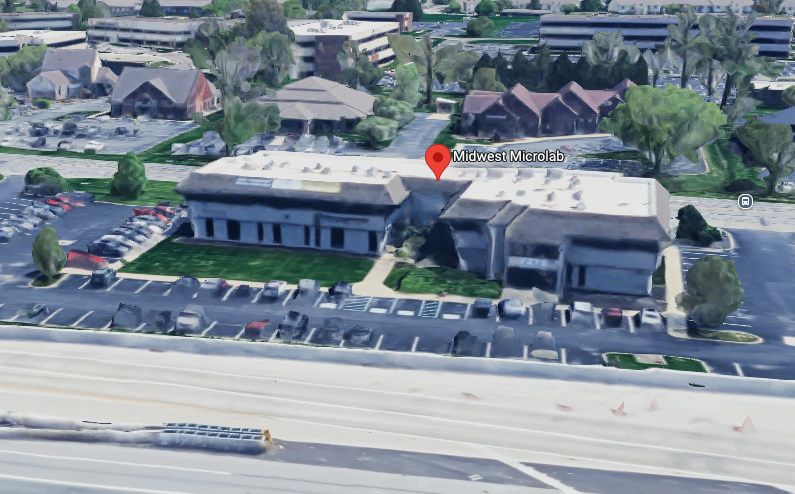
Midwest Microlab
Email Us
info@midwestlab.com
OFfice
7212 North Shadeland Ave
Suite #110
Indianapolis, IN 46250
Office Number: (317) 849-6606
Fax Number: (317) 849-8534
Monday - Friday
9am - 5pm